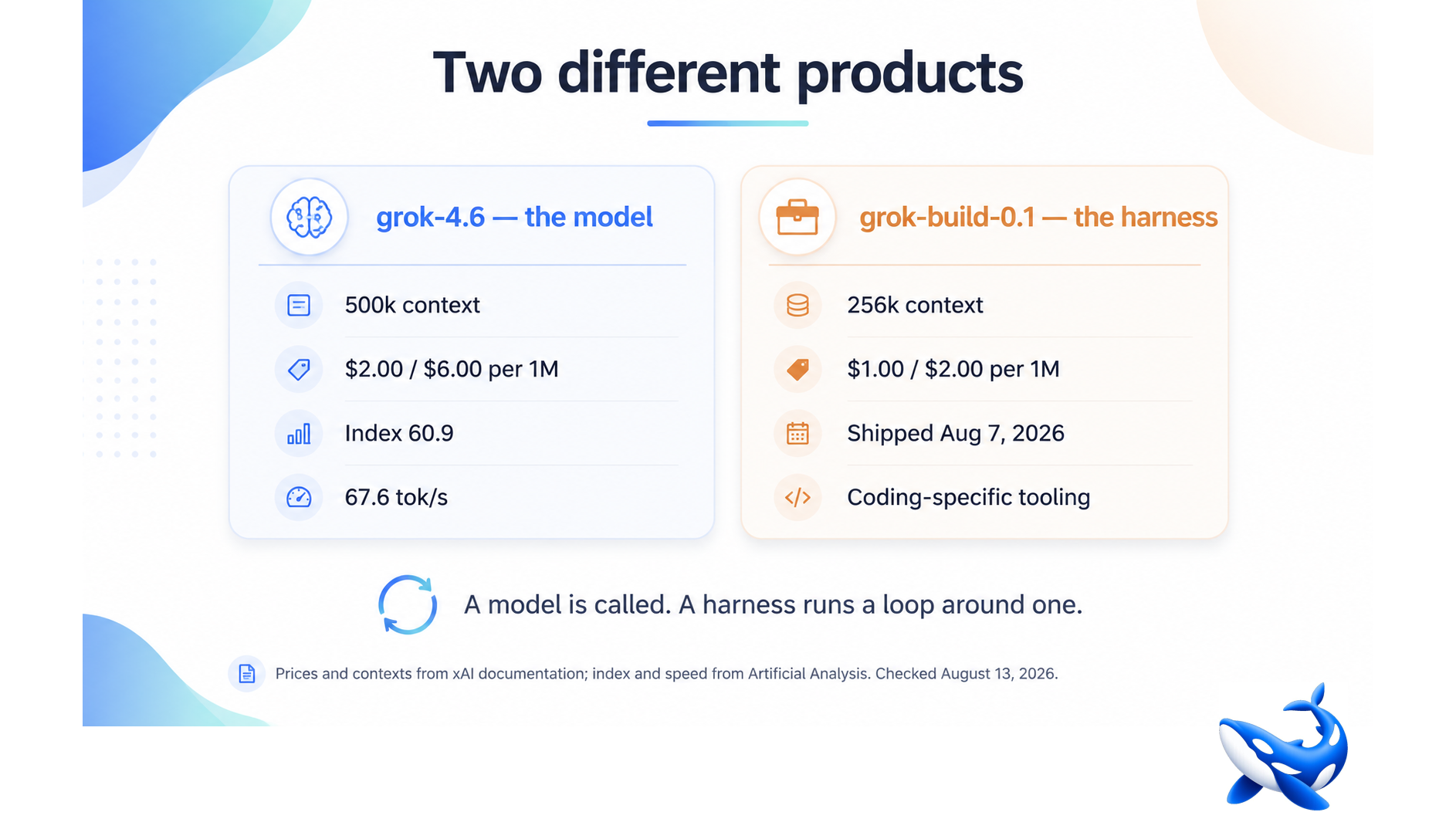
xAI shipped two things in six days, and coverage has been mixing them up ever since. Grok Build V1.0 — documented as `grok-build-0.1` — arrived on August 7, 2026. Grok 4.6, the successor to Grok 4.5, arrived on August 12. One is a coding harness; the other is a general-purpose model that happens to be good at code and is xAI’s own recommendation for code and chat. Our Grok 4.6 release notes track what shipped, when, and what it replaced.
If you’re evaluating either for engineering work, the first thing to get straight is which product you’re actually comparing.
The difference that matters
A model is something you call. You send a prompt, you get tokens back, and everything around it — reading files, running tests, retrying, deciding what to do next — is your code.
A harness is the loop around the model. Tool definitions, file access, iteration logic, error recovery. When someone quotes an agentic coding benchmark, they are quoting a *model + harness + effort budget* result, which is why the same model scores differently in different setups and why cross-vendor comparisons on the “same” benchmark are frequently not comparisons at all.
That distinction decides the evaluation. A model is evaluated on capability per token; a harness is evaluated on whether the loop finishes the job. They are not substitutes.
What each one costs
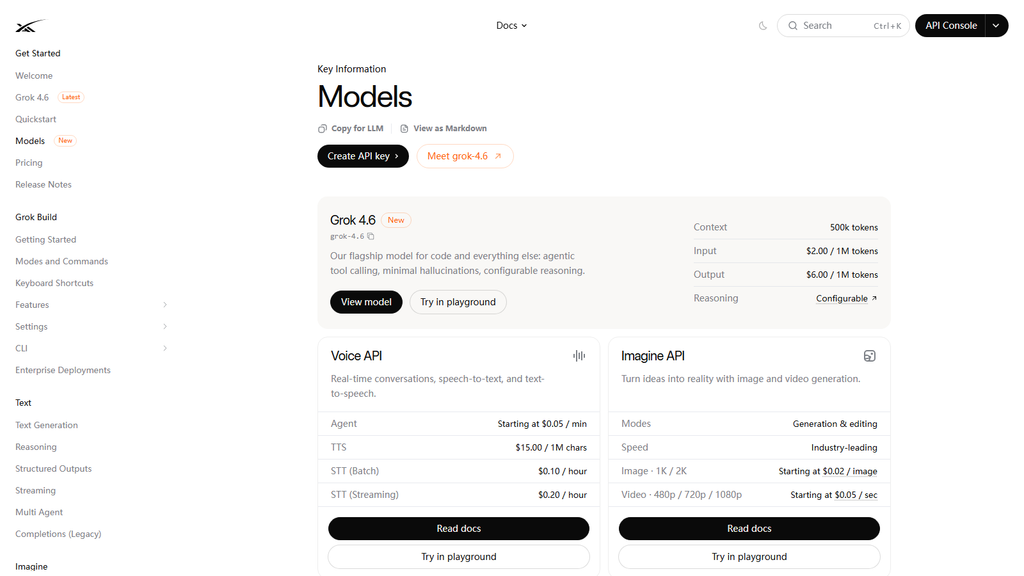
From xAI’s model documentation, checked August 13, 2026. Prices per million tokens below the 200,000-token threshold:
| grok-4.6 | grok-build-0.1 | |
| Context window | 500k | 256k |
| Input / output | $2.00 / $6.00 | $1.00 / $2.00 |
| Input / output, 200k+ | $4.00 / $12.00 | $2.00 / $4.00 |
| Cached input | $0.50 / $1.00 | $0.20 / $0.40 |
`grok-build-0.1` carries the cheapest text rate in the lineup — a third of grok-4.6’s output rate and 60% less on cached input. Its 256k window is the constraint: repository-scale context doesn’t fit, so it depends on retrieving the right files rather than holding everything.
What the model measures
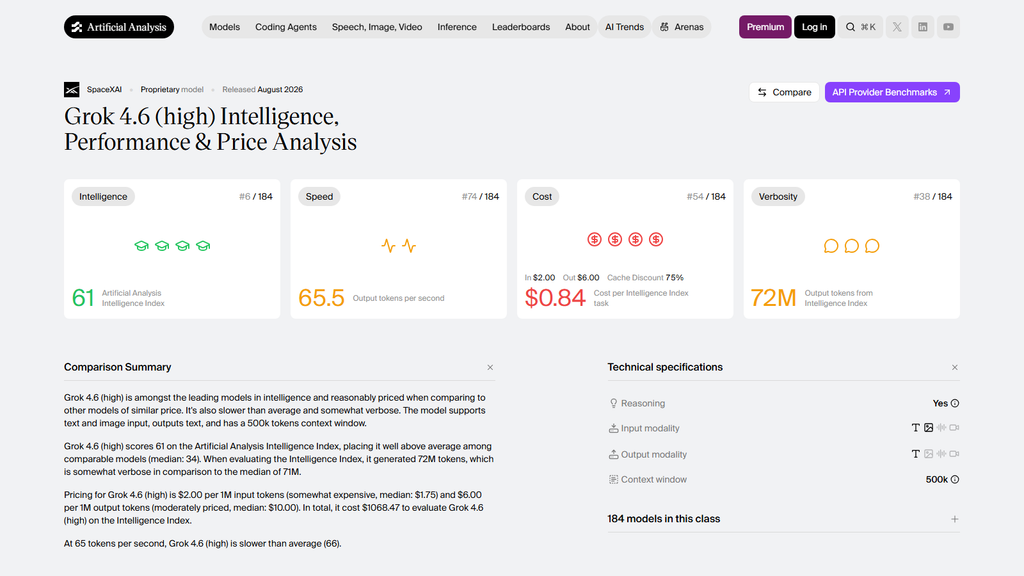
Artificial Analysis, checked the same day, configuration “high”:
| Grok 4.5 | Grok 4.6 | |
| Intelligence Index | 55.8 | 60.9 |
| Median output speed | 56.9 tok/s | 67.6 tok/s |
| Answer time | 8.79 s | 7.40 s |
| Cost per index task | — | $0.8367 |
Two of those matter specifically for coding agents.
67.6 tokens per second is the fastest of any model scoring 59 or above — ahead of Claude Fable 5 (63.2) and Claude Opus 5 (54.1). A coding agent is a long chain of sequential calls, so throughput compounds across every step rather than averaging out. That is the strongest argument for this model in agentic work.
$0.8367 per completed task is the figure to compare against alternatives, not the per-token rate. Coding agents burn enormous amounts of invisible reasoning; the token price systematically understates what a finished task costs.
The context arithmetic for code
Grok 4.6’s 500k window sounds generous and needs one qualification: the rate doubles at 200,000 tokens, applied to the whole request. A coding agent’s context grows as it works — every file read, every test output, every prior step appended — so a long session crosses that line partway through and finishes at $4.00 / $12.00.
Two practical consequences:
Prune aggressively. Keeping each step under 200,000 tokens is worth roughly twice what ordinary token-trimming is worth, because it doesn’t just remove tokens — it halves the rate on everything remaining in that call. Summarise old steps, drop stale file contents, keep only what the next step needs.
Order the prompt for caching. Cached input is $0.50 / $1.00 against a $2.00 standard rate. Prefix caching matches a prefix, so instructions, tool schemas and stable repository context must come *before* the variable step content. A step counter or timestamp at the top of the prompt costs you the entire discount.
Note that cached input on Grok 4.6 is 67% higher than on Grok 4.5 — the only rate that rose between the two models, and coding agents are exactly the workload that feels it, since they replay a stable prefix at every step.
How to evaluate either one honestly
Use your own repository, not a benchmark. Agentic coding scores are harness results. Whatever a leaderboard says, the number that matters is how a model performs inside *your* loop, on *your* code.
Count end-to-end task completion, not per-step success. A model that needs two attempts is not obviously worse than one that needs one, if it’s faster and cheaper. What matters is tasks finished per dollar and per hour.
Hold the effort level constant and record it. Reasoning models score and cost very differently across configurations, and an unstated setting makes any comparison meaningless.
Measure where the time actually goes. In most coding agents, tool calls, test runs and file I/O take more wall-clock time than generation does. Optimising the model when it’s 20% of your latency is a poor use of a week.
Check the knowledge cutoff against your stack. Grok 4.6’s is February 1, 2026, unchanged from 4.5. Libraries and APIs released after that date are outside its training, and the answer is retrieval or documentation in context — not a newer version number.
The takeaway
Grok 4.6 and Grok Build are different products released five days apart: the model is called, the harness runs a loop around one. For agentic coding the model’s strongest attribute is 67.6 tokens per second at Intelligence Index 60.9 — the fastest in the frontier band — which compounds across the sequential calls a coding loop is made of. Budget for the 200,000-token cliff, because agent context grows into it mid-session and doubles the rate on the whole request, and order your prompts so caching can match, noting that cached input costs 67% more than on Grok 4.5. Evaluate on your own repository and count finished tasks, not benchmark rows.
Sourcing note: context windows, per-token prices, cached-input rates, tier thresholds and the knowledge cutoff for grok-4.6, grok-4.5 and grok-build-0.1 are from xAI’s own model documentation, checked August 13, 2026. Intelligence Index, output speed, answer time and cost per index task are from Artificial Analysis, checked the same day, configuration “high”; that evaluator publishes no comparable index for grok-build-0.1, so no capability figure is asserted for it. The August 7 and August 12, 2026 release dates are as publicly reported.